Showing posts with label cosmic musings. Show all posts

Sunday, 9 January 2011

Felt like sharing

Yesterday night saw the first semi-clear skies in my area for the last few weeks, so I took advantage of the opportunity and took my new camera plus tripod outside for experimentation.


Couldn't resist this one.


My experimentation was cut short by a bank of cloud that rolled in at about eleven PM.


There's definitely much more I need to figure out about astrophotography.

I can now understand the infinite values of both an optical viewfinder (stars are dim enough not to show up in the electronic viewfinder at all) and a wide angle lens (which would have enabled me to point the camera straight up with landscape on all sides).

I'm a complete beginner at this photography lark, but I hope I'll make progress. I've already decided on my next camera, looks like I'll be needing a combined birthday/Christmas/Hannukah present next year.

Tuesday, 21 December 2010

Existential crisis

For a hypothetical addressee.

So you've woken up and realised that in the grand scheme of things, you aren't all that. Congratulations, welcome to the fold and etcetera. You'll be glad to know that you are far from alone.

In fact, what you've gone though happens so often that we have a name for it - existential crisis. Pretty much anyone who doesn't entirely buy into the claims of religion will experience it at some point in their lives, and gradually become aware that their life has no intrinsic worth or meaning.

The vast majority of people are scared by this eventual conclusion. I was one of them. I didn't want to dwell on it - and I dearly wished that I had never opened Pandora's box. You can put off the crisis by distracting yourself, but it grows on you, and demands resolution sooner or later.

Some people, when faced with the prospect of their life having no intrinsic value, turn to religion. They generally resolve the crisis by bathing in the reassuring claims of their favourite faith, and emerge from the crisis a hardcore religionite - utterly convinced of god's existence. They respond to criticism by digging in deeper. To me, taking this path symbolises valuing a reassuring fable above the hard reality. I could never follow this path. I care about the truth too much.

The other path is often taken to be the more difficult to traverse. But to me at least, it was the only real option. As I said, I simply care about the truth too much to take the easier way out.

I resolved my own existential crisis by asking myself a question:

Why is it so important that I be the centre of the universe?

I was unable to answer this question. I still am not. It seems to be a combination of evolutionary heritage and cultural pressures that our happiness (with exceptions like you and me) depends on a belief that we are somehow significant in the grand scheme of things.

I am content not being important. There are things that make me happy in themselves, like writing, being with the people I love, drawing, helping people in need, deep contemplation, music, and appreciation of the natural world outside.

In light of the many gifts we have been blessed with, asking for yet more seems childish. I have enough. I don't need to be the centre of everything to be happy. I'm not that vain.

Once you have conditioned yourself out of the belief that your happiness is tied to you being the centre of the universe, infinity doesn't seem that daunting any more. It's a friend that you've learned to live with.

I hope that you will come with me on the second path.

Sunday, 19 December 2010

Deep time

"We must ask ourselves, we who are so proud of our accomplishments, what is our place in the cosmic perspective of life?" - Robert Jastrow

Today I wish to consider the prospect of the future. Not simply the future, mind, but the deep, deep future. I want to examine the depths where everything becomes irretrievably dark, and see what awaits us in the deepest future of the cosmos. And why do I want to do this? Partly because I can. Partly because I must.

It starts with the stars. Stars are element factories. They smash hydrogen together and create heavier elements. The first stars were massive, and lived their lives in a figurative cosmic heartbeat. They exploded, new second generation stars formed from their remains. These too exploded, giving rise to a third generation. The cycle can only occur a limited number of times.

There is only enough hydrogen in the universe for another one or two generations, and then, slowly but surely, the stars will start going out. The biggest stars will go first. Sirius, Vega and their kin will be extinguished in mere hundreds of millions of years.

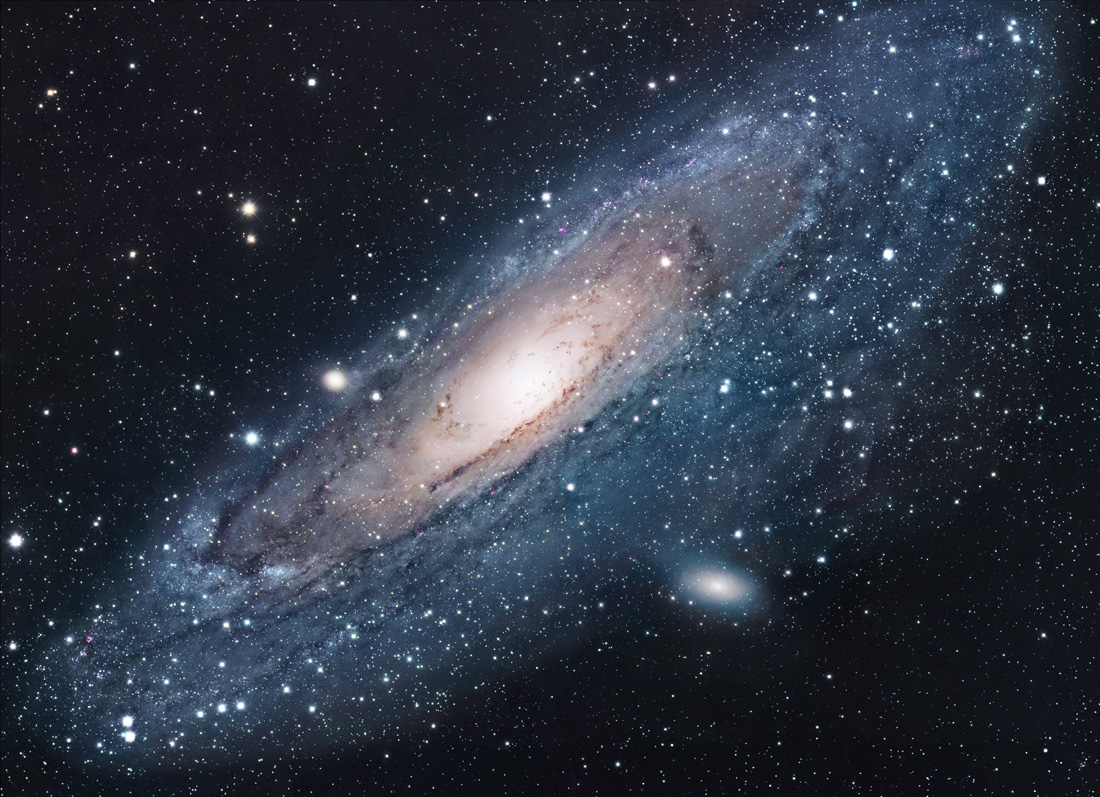
In three billion years, our own Milky Way galaxy will have begun to merge with our largest neighbour, Andromeda. They will circle each other for a time, their arms mingling. The galactic union will be consummated by the merging of the supermassive black holes that form the cores of both galaxies.

In five billion years, our own sun will take its last breaths and venture quietly into the night. There will no spectacular farewell for our parent star - it is not massive enough. No, the sun will simply inflate and fizzle. This will probably mark the end of the road for Earth as well, but the descendants of today's humans might still survive by journeying to other stars. The party isn't fun any more - everyone's leaving.

But the universe is a closed system. You can buy time, but sooner or later, everything winds down to nothing.

By the year one trillion, there will be no stars like the sun left. The only stars left will be diminutive red dwarfs, tiny balls glowing feebly with a barely perceptible incandescence. By this time, star formation will have slid to a half as hydrogen stores run dry throughout the universe.

But wait, there's more.

Red dwarfs need fuel, just like the long-dead larger stars. They don't burn it as quickly, but by the year twenty trillion, the last red dwarfs will be winking out. The universe will have become very dark, and the last sources of light are going. To our eyes, it would be simple blackness. No constellations. No nebulae. No galaxies. Planets and moons might still exist, but nothing we'd recognise as life could survive on their now-frigid surfaces.

Continuing to forge through deep, logarithmic time, black holes will eventually be the only objects in the universe. All activity in the cosmos will wind down to a halt.

But the cosmos has one last surprise. Black holes don't live forever either. They constantly lose imperceptible amounts of mass, evaporating over time. The universe's last call will be the death of the last black hole. From that second onward, the universe will consist of nothing but elementary particles, separated by great stretches of space.

These particles will continue to spread apart as space expands, but the universe is now essentially dead.

In the deep future, the universe will get painfully dark, painfully cold, and painfully big. The immense nothingness alone would eliminate us, if we somehow managed to survive for that long. This is all that awaits us. There will be no eleventh-hour rescues, no escapes, no way out. This future is inevitable, and it gets closer each passing day.

So take these thoughts and internalise them. Realise that This. Will. Happen. Make yourself realise that this is not a fiction, not a story. It is reality, and reality is hard to take sometimes.

Friday, 17 December 2010

Thoughts under a shooting star

If you don't already know, this past week our little world crossed the orbit of the asteroid 3200 Phaethon (say it FAY-a-thon).

As Phaethon orbits, getting closer to and further from the sun in perpetuity, debris breaks off from the main rock and gets strewn about its orbit. Well, as we passed through this debris trail, some of the objects entered our atmosphere, causing the annual phenomenon known as the Gemenid meteor shower.

Long-exposure of a Gemenid meteor. It's up left.

The Perseid and Leonid meteor showers (midsummer and November, respectively) have been persistent disappointments to me, due in part to light pollution and frequently cloudy skies above the West Midlands. However, this year, I saw my first Gemenid.

They're slow-moving, fairly bright compared to the background stars and can be mistaken for planes if one doesn't look too closely. This was only the second shooting star that I recall observing, and seeing this one reminded me of the first, a few years ago.

I was in Devon on a residential school trip for geography. The place we were staying at, from what I remember, had a garden up front, with a solitary bench, that looked out on to an open, flattish landscape with hills on either side. One night, myself and a friend were on the bench and happened to observe a fantastic meteor pass overhead and trace a nearly perfect vertical path to the ground.

Everything about the scene seemed to conspire to make all the details perfect. The angle of the bench, the exceptionally clear skies, the brightness and vector of the meteoroid, the way the hills framed the sky. All of the variables in play came together with an uncanny synchronisation, that as a whole seemed to suggest that something profound had just happened.

If I had the kind of mind that was prone to invoking an intelligent overseer, I might have concluded that the scene was designed purposefully for my benefit. But of course, it wasn't. Unlikely things happen all the time. In fact, it would be more interesting if odd synchronicities didn't occasionally emerge.

The scene had an air of perfection to it, and in that particular moment, I experienced a fleeting sense of oneness with my surroundings, and awe at the cosmos, that left me in hushed silence for several seconds. Just because I'm not religious doesn't mean that I deny myself spiritual experiences.

Monday, 13 December 2010

Entropy's march

We are dying.

As you read. As I write. As we live our lives.

We are dying.

Why?

Take a new deck of cards. Spades, hearts, clubs and diamonds, all in pristine order. Now shuffle. They aren't in order any more. Shuffle again. Still not in order. In fact, you can shuffle from now till the stars go out, and you will, in all likelihood, never end up with a perfectly ordered deck again.

Welcome to entropy - the reason you're dying.

Entropy is the observed, inexorable march from order to disorder that seemingly prevails everywhere in nature. Glasses break, they don't spontaneously reform. Your desk will become untidy, and will not become tidy by itself. Water flows downhill, not uphill.

Constantly, things are sliding down toward disorder. Of course, when it happens to us, we don't call it entropy. We call it aging.

We humans are kept alive through the exquisitely structured chemical reactions of metabolism. And yet, metabolism isn't perfect. As it ticks over, it lays down accumulating damage that will eventually cross a threshold and kill us. This is how entropy is written on our soul.

The same thing that keeps us alive is what eventually kills us. The cosmos giveth and the cosmos taketh. Death is just a consequence of being alive in the first place.

Life is a package holiday, and death comes inclusive. So don't let it get you down. It couldn't be any other way.

Instead, dwell on this.

You get to live twice as long as your great, great, great grandparents. Twice as long. Twice as much time to live your life. Twice as much time to love your friends and family. Twice as much time to help your fellow primates. Twice as much time to leave a positive mark on the world.

Sunday, 12 December 2010

Optimism in the cosmos

Reading some of these posts, you might think I'm pessimistic about humanity's place in the cosmos. Well, that's only a half-truth.

The universe is indifferent to our existence. It doesn't know we're here. If we were all snuffed out tonight, it wouldn't notice we were gone. It owes us nothing. It simply is. It doesn't care one way or another. In many ways, this is more difficult to accept than if the universe were actively out to get us - many people would prefer to believe in a hostile universe than a blind, apathetic one.

At least if the cosmos were malevolent, we would have an outside force to which our failures could be attributed. But if the alternative is true, if the universe truly doesn't care, then there is no one to blame our failings on. There is no parent looking over us and no cradle to return to when we become afraid.

But take heart. If we overcome our fear of being tiny, there are wonders to be had.

We dutifully explore our own origins. We design and redesign agriculture, without which billions would starve to death. We manufacture vaccines that spare unthinkable suffering. We create great works of art and culture, and contemplate our own cosmic circumstances.

And we are beginning to explore the stars.

The significance of our lives, and our fragile little world, are then determined by our knowledge, wisdom and bravery. So on the contrary, I am an optimist till the end. I find it preferable to embrace a difficult truth than a reassuring myth, but I feel there's potential to our species yet unseen.

Saturday, 11 December 2010

Dots in the dark

We don't have many good constellations here in the north hemisphere. Orion's our best, of course, but there's so much light pollution about you'd be hard pressed to see him even on a clear night.

Last Tuesday, it was a very clear night. I was still awake at about one AM, and by chance happened to look at the sky. Orion and his friends, tiny, brilliant pin-pricks of light against the dark veil of night. I don't know why the stars affect me this deeply, but they do, and I'm glad for it.

Each of those sparkling dots is a mighty ball of searing thermonuclear plasma, as big as, or bigger than, our own sun, perhaps shepherded by smaller spheres, like our tiny world orbits our sun.

I stared up at the stars, dumbstruck, neck craned. I want so much to sail among them.

The sky makes some people convinced of their religion. It makes me convinced of the opposite. I imagine a civilisation riding around one of those distant shimmering orbs, proudly proclaiming 'We're at the centre. Everything was made for us," and I consider how seriously I would take their claim.

Friday, 10 December 2010

To pass through life oblivious...

A vast majority of people on this planet will live their lives without ever knowing the things I know. That sounds self-indulgent and condescending, but I don't mean it to be so. I simply consider it sad.

I know, for example, that the atoms that make up my fragile biological form, have been rattling about at the bottom of Earth's gravity well for the better part of 4.5 billion years. Atoms in my body now have been part of Voltaire, Shakespeare, da Vinci, and yes, even Hitler and Ghengis Khan.

I know I am not a static thing. Constantly, atoms enter me from the ecology outside. Constantly, atoms return to that same ecology. I am forever changing. I am a pattern with continuity in time. And not even the pattern is constant.

It is beautiful to think that one day, billions of years hence, this world will likely be obliterated in the nuclear fire of an expanding star. At that instant, all those atoms which have been bottled up for so many thousands of millenia, will finally be released, retracing the steps of the journey they once took before.

I am glad I know these things, because I know how painfully easy it would be for me to have, by accident of birth, be born into a culture which was unaware of them. I would have gone my whole life unaware of the miracle of the stars.

I like to think that I would still have yearned for them.

It pains me, deep in my chest, to think that I am constantly surrounded by people who could easily access this information if they wished, and let these sublime truths fill them, but they choose not to. They choose not to. They find the study of the world we live in distasteful.

I go to college at the moment. I would dearly love to make them listen to ten minutes of Carl Sagan rather than another derivative rendition of 'Journey'.

Neil deGrasse Tyson: "I know that the atoms in my body are traceable to phenomena in the cosmos. That makes me want to grab people in the street and say ' have you heard this?'"

Exactly.

I console myself by understanding that regardless of what could have happened, I do know these things. It's my goal to help other people know them too.